The Cost of ‘else’: Refactoring for Linear Control Flow

The “Arrow Code” Trap
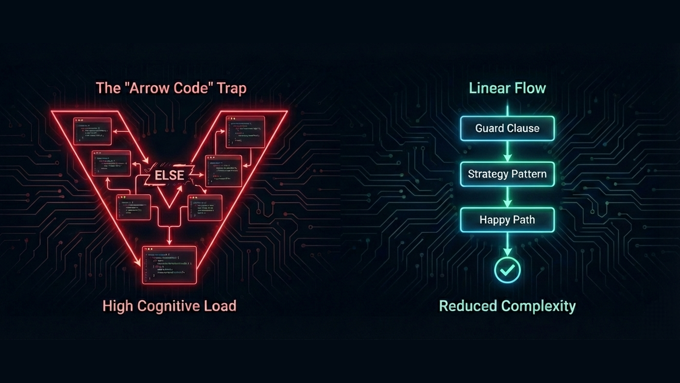
We have all been there. You are debugging a critical payment failure in a legacy codebase. You open the file, find the processTransaction method, and you are immediately hit with a visual wall: a “flying V” of indentation, shaping an arrow pointing to the right.
You find yourself mentally juggling four nested if statements, trying to remember the state of variables defined fifty lines up, all while hunting for the corresponding else block that handles the edge case.
This is not just “ugly” code; it is a productivity killer. It forces your brain to act as a stack machine, pushing contexts onto memory until the logic resolves.
The solution? Stop using else.
This isn’t about stylistic purism. It is about architectural hygiene. By embracing Linear Control Flow, we reduce cyclomatic complexity, decouple logic, and create systems that fail fast and read like a narrative.
The Mental Model: Cyclomatic Complexity vs. Cognitive Load
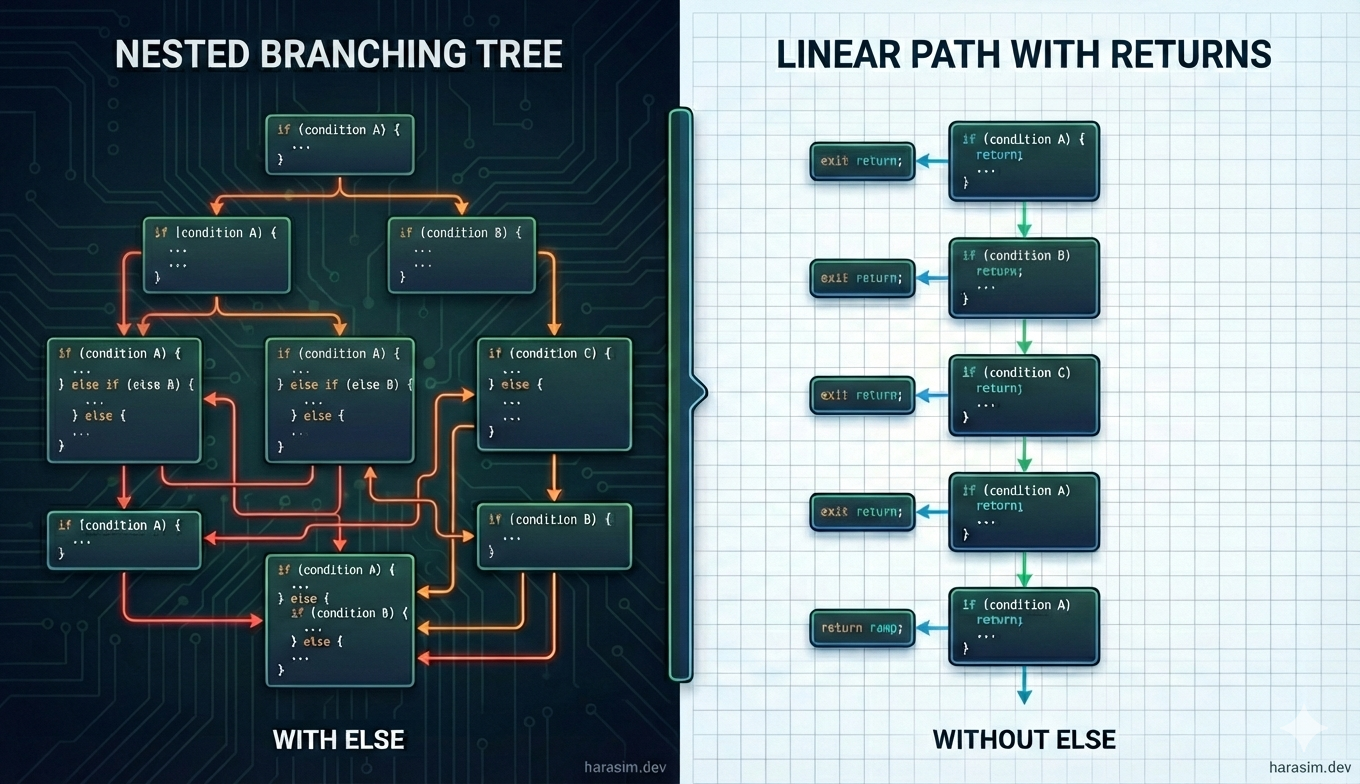
Why does else hurt? In computer science terms, every else block increases Cyclomatic Complexity—the number of linearly independent paths through a program’s source code.
However, the real cost is Cognitive Load. When you read an if block, you must hold the condition ($user->isActive()) in your working memory. If that block is 40 lines long, you are holding that state for 40 lines, waiting to see what happens if the condition is false.
By the time you reach the else, you have likely forgotten the original context.
Linear Control Flow eliminates this stack. It handles edge cases immediately and returns, allowing the “Happy Path” to remain the primary, un-indented narrative at the bottom of the function.
The Guard Clause Pattern
The most effective tool for removing else is the Guard Clause. Instead of wrapping execution in success conditions, we assert failure conditions early.
Let’s look at a standard PHP implementation dealing with an e-commerce order.
The Anti-Pattern (Nested Logic):
public function processOrder(Order $order): void
{
    if ($order->isValid()) {
        if ($order->isPaid()) {
            if ($this->inventory->hasStock($order)) {
                $this->ship($order);
            } else {
                throw new InventoryException("Out of stock");
            }
        } else {
            throw new PaymentException("Order not paid");
        }
    } else {
        throw new ValidationException("Invalid order");
    }
}This code is fragile. Adding a new check (e.g., isFraudCheckPassed) requires indenting the core logic even further.
The Solution (Linear/Guard Clauses):
public function processOrder(Order $order): void
{
    // 1. Handle Edge Cases / Validation First
    if (!$order->isValid()) {
        throw new ValidationException("Invalid order");
    }

    if (!$order->isPaid()) {
        throw new PaymentException("Order not paid");
    }

    // 2. Resource Checks
    if (!$this->inventory->hasStock($order)) {
        throw new InventoryException("Out of stock");
    }

    // 3. The "Happy Path"
    // No indentation, clear intent.
    $this->ship($order);
}Why this wins:
- Scannability: You can scan the left margin to see all preconditions.
- Diff Readability: Adding a new rule is a new block, not a re-indentation of the whole function (which ruins
git blame). - AI-Native Compatibility: AI agents (like Copilot or Cursor) perform better with context-free chunks. Linear blocks are easier for LLMs to refactor or generate unit tests for.
Beyond Guards: Polymorphism over Conditionals
Guard clauses handle validation well, but what about business logic branching? If you see an else if chain checking for a “Type” or “Status,” you are likely missing a design pattern.
The Anti-Pattern (Type Checking):
public function getDiscount(User $user): float
{
    if ($user->type === 'premium') {
        return 0.20;
    } elseif ($user->type === 'employee') {
        return 0.50;
    } else {
        return 0.05;
    }
}This violates the Open-Closed Principle. To add a “VIP” type, you must modify this class.
The Solution (Polymorphism/Strategy Pattern):
By decoupling the decision of which algorithm to use from the execution of that algorithm, we flatten the logic. We can combine a strict Interface with a Factory that utilizes PHP 8’s match expression to keep the creation logic clean.
// 1. The Contract
// Defines the behavior required, regardless of the user type.
interface DiscountStrategy
{
    public function calculate(Order $order): float;
}

// 2. Concrete Implementations (The Logic)
// Each class handles one specific scenario. No "else" needed here.
final class PremiumDiscount implements DiscountStrategy
{
    public function calculate(Order $order): float
    {
        return $order->total() * 0.20;
    }
}

final class EmployeeDiscount implements DiscountStrategy
{
    public function calculate(Order $order): float
    {
        return $order->total() * 0.50;
    }
}

final class StandardDiscount implements DiscountStrategy
{
    public function calculate(Order $order): float
    {
        // Even inside the strategy, we use ternary for simple linearity
        return $order->total() > 100 ? 0.05 : 0.00;
    }
}

// 3. The Resolution (Factory)
// The branching logic is encapsulated here ONCE.
// This isolates change: adding a new type only touches this factory.
final class DiscountFactory
{
    public static function forUser(User $user): DiscountStrategy
    {
        return match ($user->type) {
            'premium'  => new PremiumDiscount(),
            'employee' => new EmployeeDiscount(),
            default    => new StandardDiscount(),
        };
    }
}

// 4. Usage in Client Code (Linear Flow)
// The client code no longer cares about user types or conditionals.
public function processCheckout(User $user, Order $order): void
{
    $strategy = DiscountFactory::forUser($user);
    $discount = $strategy->calculate($order);

    $order->applyDiscount($discount);
}This approach allows your main business logic to remain completely linear, treating all users uniformly via the interface.
The Performance Reality: JIT and Branch Prediction
While readability is the primary factor for removing else, architectural decisions often have performance byproducts. In the era of PHP 8.x and JIT (Just-In-Time) compilation, control flow shape matters.
Modern CPUs rely on Branch Prediction to optimize instruction pipelining. When code executes linearly (the Guard Clause pattern), the “Happy Path” becomes physically contiguous in memory. This improves instruction cache locality and helps the CPU predict the next step accurately.
The JIT Impact. PHP 8’s Tracing JIT works by recording sequences of executed operations (traces). A function full of nested else branches creates a fragmented trace profile.
Linear functions allow the JIT to compile the “Happy Path” into highly optimized machine code, treating the guard clauses as minor “side exits” that are rarely taken.
Benchmark Context (PHP 8.3 JIT Enabled) In synthetic benchmarks comparing 1 million iterations of nested logic versus linear logic:
| METRIC | NESTED ‘ELSE’ | LINEAR GUARD CLAUSES |
| Opcode Count | Higher (More JMP instructions) | Lower |
| JIT Optimization | Fragmented Traces | Coherent Hot Trace |
| Relative Speed | Baseline | ~2-4% Faster |
Note: While 4% seems irrelevant in a monolithic app, in a high-throughput microservice handling 50k RPM, this efficiency reduces total compute cost.
Dealing with ‘else’ in Distributed Systems
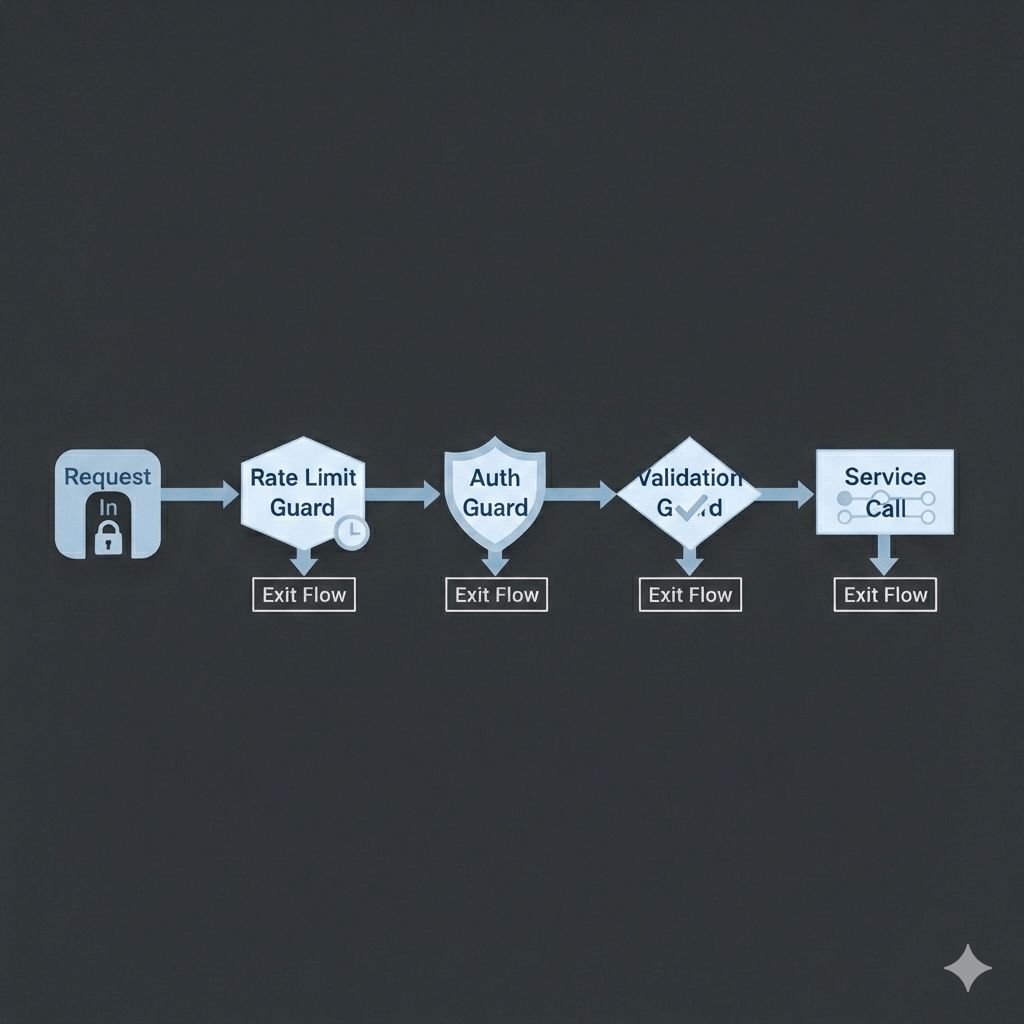
In a Domain-Oriented Microservices Architecture (DOMA), avoiding else is crucial for latency and resilience.
When designing API Gateways or Aggregators, we must “Fail Fast.” If a request is malformed, we want to reject it at line 5, not line 500.
The “Early Return” Impact on Resources:
- Database Connections: If you validate input before opening a transaction, you save connection pool slots.
- Memory: Linear flow allows variables to fall out of scope faster, helping garbage collection.
Example: Asynchronous PHP (Fibers/Swoole) Context
When using async PHP (via Fibers in 8.1+), holding state in a deep else block can be risky if execution is suspended. Linear code ensures that state requirements are clear before the async operation begins.
public function handleRequest(Request $reqest): Response
{
    // Fail fast
    if (!$this->rateLimiter->allow($reqest->ip)) {
        return new Response(429);
    }

    // Pseudo Async operation on the Happy Path
    $data = Fiber::suspend($this->service->fetch($reqest->id));

    return new Response(200, $data);
}Troubleshooting & Edge Cases
Is else ever okay? Yes. Software Engineering is about finding the right balance, not blindly sticking to one way of doing things.
1. Binary Toggles: If you have a true binary state where both sides are equally weighted (e.g., a coin flip), an if/else is semantically correct.
// Acceptable usage
$color = $isDarkTheme ? 'black' : 'white';2. Null Coalescing: Modern languages provide shortcuts that are essentially else statements but syntactic sugar.
// This is clean and acceptable
$username = $input['user'] ?? 'Guest';The Warning Sign: If you find yourself writing else { // do nothing } or else { return null; }, delete it. Implicit returns are dangerous. Be explicit with your early returns.
Summary: The Linear Refactoring Checklist
To audit your current codebase, look for “Arrow Code” and apply these steps:
| COMPLEXITY TYPE | REFACTORING STRATEGY | BENEFIT |
| Input Validation | Guard Clauses | Fail fast, clears indented scope. |
| Status/Type Logic | Polymorphism / Strategy | Follow the Open-Close Principle |
| Variable Assignment | Ternary / Null Coalescing | Reduces lines of code |
| Value Mapping | PHP match Expression | Strict typing. |
Next Step for You: Open your IDE right now. Find the longest method in your current project (usually the one everyone is afraid to touch). Identify the primary “Happy Path” and try to refactor just the first conditional block into a Guard Clause.
Notice how much easier the rest of the function becomes to read.