

The Engineering Productivity Ladder: From Quick Hacks to Deep Strategy

Refactoring Your Output
Most of us end our workdays feeling exhausted but wondering what we actually accomplished. Between constant Slack pings, back-to-back meetings, coding and the pressure to review code, it feels like we are constantly running just to stay in the same place.
I’ve spent years looking for ways to be more productive. I treat my workflow like a production system: I’m constantly testing, looking for memory leaks in my schedule, and trying to improve capacity. Some methods are production-ready, but others – like the Pomodoro Technique – don’t scale well for me.
I find Pomodoro too strict for complex engineering. It’s like a “hard timeout” that kills a process right before it finishes. When you’re building a complex mental model of a system, you don’t want a timer forcing a context dump every 25 minutes.
Below are five methods I’ve found useful, sorted from the easiest to start today to the ones that require the most change.
1. Bounding Box Logic (Parkinson’s Law)
Complexity: ★☆☆☆☆ (A simple mental heuristic)
The Analogy: Work expands to fill the time available. It’s like a memory leak; if you don’t set a limit, it will consume every resource you have.
How to implement: If you give yourself a whole sprint to research a new library, you’ll spend two weeks on it. Instead, set an aggressive “time-box.” Tell yourself you have exactly one hour to pick a library and write a proof-of-concept. This forces you to focus on the core requirements and ignore the “gold-plating.”
2. The 5-Minute Rule (Overcoming Static Friction)
Complexity: ★★☆☆☆ (A quick behavioral patch)
The Analogy: In physics, it takes more force to get an object moving than to keep it moving. Procrastination is just static friction. When a task like “Migrate the Database” feels too heavy, your brain refuses to start the process.
How to implement: Break the task down into an “atomic commit.” Don’t try to migrate the whole DB. Just tell yourself you’ll work on the schema mapping for five minutes. Once you’ve overcome the initial friction of opening the IDE, the “kinetic energy” of the work usually keeps you going.
3. Flow-Based Sprints (Flowmodoro)
Complexity: ★★★☆☆ (Process optimization)
The Analogy: Think of your focus like a cache. It takes 15–20 minutes to “warm up” the cache with all the context of the code you’re writing. Standard Pomodoro (25-minute blocks) clears that cache right when it gets warm.
How to implement: Instead of a fixed timer, use a stopwatch. Work as long as you are in a Flow State. When you hit a natural breaking point—like a passing test or a finished function—then you trigger your break. This way, you don’t interrupt your own “execution loop” when it’s running at peak performance.
4. Priority Queueing (The Eisenhower Matrix)
Complexity: ★★★★☆ (A priority queue for your life)
The Analogy: This is your load balancer. If you don’t filter incoming requests, you’ll spend your whole day handling low-priority “pings” while your main database crashes in the background.
How to implement: Sort your tasks into four quadrants:
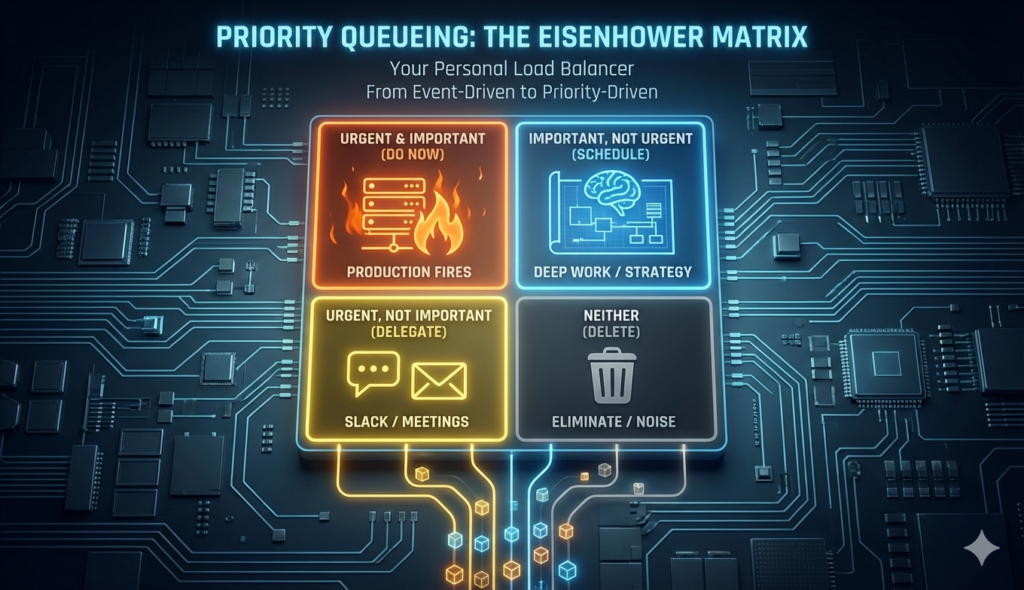
- Urgent & Important: Production fires. Handle immediately.
- Important, Not Urgent: This is the “Deep Work” quadrant. This is where you architect systems and prevent future fires.
- Urgent, Not Important: Most Slack messages and meetings. Delegate these if possible.
- Neither: Pure noise. Delete these.
Your goal is to stop being “event-driven” (reacting to every interrupt) and start being “priority-driven.”
5. Single-Threaded Execution (The ONE Thing)
Complexity: ★★★★★ (A major architectural change)
The Analogy: Your brain is a single-core processor. Every time you “multitask,” you are actually context-switching, which creates massive overhead. This is the hardest level because it fights against organizational culture. Modern tech companies push for concurrency (multitasking), but your brain is single-threaded.
How to implement: Identify the ONE thing that, if finished, makes everything else easier or unnecessary. Block off 3–4 hours of your morning for this task. Set your Slack status to “Deep Work” and turn off all interrupts. By focusing 100% of your “bandwidth” on one task, you’ll finish it faster and with higher code quality than if you tried to juggle five things at once.
Troubleshooting & Next Steps
If you are currently drowning in tickets, do not jump straight to Level 5. You cannot block out 4 hours a day if you cannot yet prioritize your backlog.
Your Action Plan:
- This Week: Apply Level 1 (Parkinson’s) to your next documentation task. Cut the time in half.
- Next Week: Audit your backlog using Level 4 (Eisenhower).
- Next Month: Attempt a Level 5 (ONE Thing) morning block once a week.
I am curious where you sit on this ladder. Have you successfully implemented “The ONE Thing” in a chaotic startup environment? Or are you sticking to modified Pomodoros?
Let me know in the comments. Let’s find the method that survives production.