Strict vs. Loose Comparison in Modern PHP: Why Identity Always Wins

In modern PHP development, a long-standing debate is finally being settled. Many developers thought that using declare(strict_types=1) made the strict identity operator (===) unnecessary for comparing simple values like strings or integers. However, as we move toward PHP 9.0, that assumption is proving to be incorrect. Even with strict typing in our functions, experience shows that using === still matters for reliability – a fact I recently confirmed through a detailed technical review.
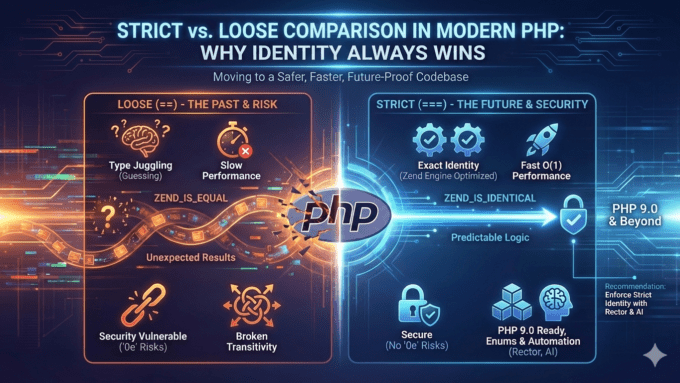
The problem is that loose comparison (==) relies on “type juggling,” where the PHP engine tries to guess your intent by changing data types on the fly. This leads to “ghost” bugs that are hard to find and easy for hackers to exploit. The solution is to move entirely to strict identity (===) and use automated tools to enforce this rule across your codebase.
Under the Hood: The Zend Engine Difference
To understand why one is better, we must look at how the PHP engine (the Zend Engine) handles your code. When PHP sees a comparison, it uses different commands called “opcodes”:
- Loose Comparison (
==): Generates theZEND_IS_EQUALopcode. This command triggers a complex “state machine.” The engine must check if the types match. If they don’t, it follows a list of rules to convert them, which takes more CPU time and memory.
- Strict Comparison (
===): Generates theZEND_IS_IDENTICALopcode. This is a very fast, linear path. The engine first checks the type tag in the internal data structure (thezval). If the types are different, it returnsfalseimmediately without even looking at the value.
| Feature | Loose (==) | Strict(===) |
| Opcode | ZEND_IS_EQUAL | ZEND_IS_IDENTICAL |
| Logic | Type Juggling (guessing) | Exact Match |
| Performance | Slower (requires casting) | Fastest (O(1) complexity) |
| Risk | High (unexpected results) | Zero (predictable) |
Mathematical Flaws: The Transitivity Trap
In math, if A = B and B = C, then A must equal C. This is called “transitivity.” Loose comparison in PHP breaks this rule.
Example, in PHP 7.4 and lower:
var_dump(
    true == 'a', // is true
    'a' == 0,    // is true
    true == 0,   // is false
);This makes sorting or filtering data very difficult. Another issue is NAN (Not a Number). Per the IEEE 754 standard, NAN is never equal to anything, including itself.
NAN != NAN
$NaN = sqrt(-1);

var_dump(
    $NaN,           // float(NAN)
    $NaN === $NaN,  // false
); Strict comparison handles this correctly by returning false, but it highlights that you must always know exactly what data you are comparing.
Why Strict Comparison is Better for Modern Features
Modern PHP features are designed to work best with strict identity.
Enums (Enumerations)
Enums (introduced in PHP 8.1) are singleton objects. This means they only exist once in memory. Because of this, comparing Enums with === is the standard best practice. It is safer and much faster than comparing strings.
PHP 9.0 Roadmap
PHP is moving toward even more strictness. In PHP 9.0, many “fuzzy” behaviors will become errors. For example:
- String Increments: Incrementing a string like
'a9'++currently gives'b0'. It is deprecated since PHP 8.5. In PHP 9.0, this will throw aTypeError. - False to Array: Automatically turning a
falsevalue into an array will no longer be allowed.
By using === now, your code is “future-proofed” for these changes.
Automation: Rector and Agentic AI
Moving a large project from loose to strict comparison can be overwhelming. Thousands of lines might need changes. Fortunately, you don’t have to do it manually.
- Rector: This tool can scan your entire project and automatically swap
==for===using specific “rulesets.” It can finish in days what would take a human months. - Agentic AI: New AI agents like Moderne or Aider can act as virtual developers. They use “reinforcement learning” to identify technical debt and apply refactoring across multiple files while running tests to make sure nothing breaks.
The Verdict: Why Identity Wins
Strict comparison (===) is objectively better than loose comparison (==) for three reasons:
- Speed: It skips the expensive type-conversion logic in the Zend Engine.
- Security: It prevents hash collision attacks and “type juggling” bypasses.
- Predictability: It follows strict logical rules, making your code easier to debug and more stable for future PHP versions.
| Criterion | Loose Comparison (==) | Strict Comparison (===) |
| Logic | Guessing / Juggling | Explicit Identity |
| Security | Vulnerable to “0e” attacks | Secure |
| Static Analysis | Hard to analyze (mixed types) | Perfect (Level 10 ready) |
| Future Proofing | Will break in PHP 9.0+ | Compatible with PHP 9.0+ |
Recommendation
Set your static analysis tools (like PHPStan) to Level 9 or 10. This will force your team to use === and handle types explicitly. Use Rector to automate the migration of old code. The era of “guessing” in PHP is over; the future is built on strict identity.