Is Spec-Driven Development an Engineering Standard?

You give an AI agent a prompt, it generates a few hundred lines of code, and for a moment, you feel like a 10x developer. Then you run it. It breaks a service three layers deep in your stack because the LLM didn’t “see” the architectural constraints of your legacy system. This is the vibe coding trap: a cycle of rapid generation followed by hours of reactive debugging and “context-switching death spirals” that drain your team’s most senior talent.
The problem isn’t that the AI is “dumb”; it’s that it’s a pattern matcher, not a mind reader. Without a formal plan, the AI is forced to guess your intent, leading to “integration hell” where services fail during deployment because teams (and their agents) made incompatible assumptions.
Spec-Driven Development (SDD) solves this by inverting the relationship between requirements and implementation. Instead of treating documentation as a stale afterthought, SDD makes the specification the “executable truth” that governs every line of code generated. By the end of this article, you’ll understand how to implement this workflow to turn AI from a shaky autocomplete into a precise engineering partner.
Moving Beyond “Vibe Coding”: The SDD Maturity Model
The competitive edge isn’t how fast you can type; it’s how accurately you can specify. Most organizations fall somewhere on this maturity scale, and moving up that scale is the difference between manageable systems and a “Markdown Monster” of outdated docs.
| Maturity Level | Role of the Specification | Relationship to Code |
|---|---|---|
| Spec-First | A blueprint written to guide initial AI prompts. | The spec is often discarded or drifts after delivery. |
| Spec-Anchored | A living artifact versioned alongside the code. | Code evolves with the spec; drift is blocked by CI/CD. |
| Spec-as-Source | The primary artifact; code is a generated derivative. | Manual code edits are discouraged or prohibited. |
For software architects, Spec-Anchored is the target. It allows for human creativity while using tools like GitHub Spec Kit to ensure the AI follows a “Project Constitution” – a set of non-negotiable principles like “always use parameterized queries” or “never use try-catch in route handlers.”
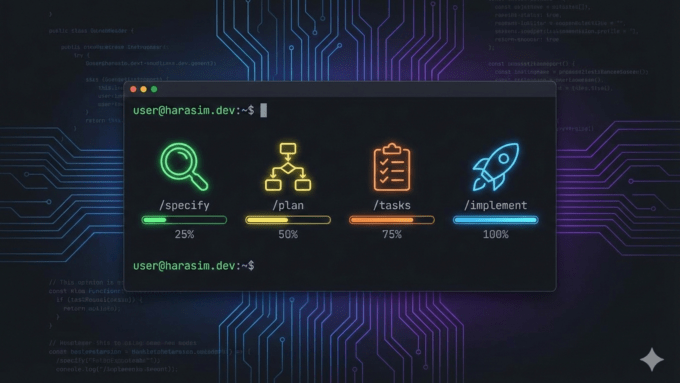
Operationalizing Intent: The 4-Phase Workflow
Spec-Driven Development isn’t about writing 50-page PDFs. It’s a structured loop that moves technical decisions upstream, so Implementation becomes a boring, predictable task for the AI.
1. Specify (The “What”)
The goal here is to define user journeys and success criteria without mentioning technology. If you find yourself arguing about PostgreSQL vs. MongoDB in this phase, you’ve already lost. You are documenting the “what” and “why” to provide the AI with the business context it needs to avoid “hallucinating” features you don’t want.
2. Plan (The “How”)
Once the requirements are locked, you define the architecture. This includes data models, API contracts (OpenAPI/AsyncAPI), and technology choices. In an SDD workflow, this is where you feed the agent your Constitution. If your team uses a specific service-layer pattern, the Constitution ensures the AI doesn’t decide to invent a new one at 2:00 AM.
3. Tasks (The Breakdown)
The AI agent takes the spec and the plan to generate a list of “atomic tasks.” Each task must be small enough to be implemented and tested in isolation. This “Reviewable Chunk” strategy prevents the AI from losing the plot over a long implementation window, essentially creating a Test-Driven Development (TDD) loop for the agent.
4. Implement (The Execution)
The agent executes the tasks. However, in SDD, the code is just a candidate. Automated validation gates (like Specmatic or TestSprite) check the implementation against the original spec. If the code deviates from the contract, the build fails instantly.
The Spec-as-Source Standard: PHP & API Platform
For PHP developers, API Platform (built on Symfony) is the gold standard for “Spec-as-Source” development. It demonstrates how code can be a mere derivative of a well-defined resource.
Instead of writing controllers, you define your domain model with attributes. The framework then derives the OpenAPI spec, the JSON-LD context, and the documentation automatically. This approach is the baseline for the industry because it eliminates the possibility of documentation drift.
// src/Entity/InventoryItem.php
namespace App\Entity;

use ApiPlatform\Metadata\ApiResource;
use Symfony\Component\Validator\Constraints as Assert;

#[ApiResource]
class InventoryItem
{
    public ?int $id = null;

    #[Assert\NotBlank]
    #[Assert\Length(min: 3, max: 64)]
    #[Assert\Regex(pattern: '/^[A-Z0-9\-]+$/', message: 'SKU must be alphanumeric and uppercase.')]
    public string $sku;

    #[Assert\NotNull]
    #[Assert\PositiveOrZero]
    #[Assert\Type(type: 'integer')]
    public int $quantity = 0;
}By defining the InventoryItem as a resource, you have effectively created a contract. The AI doesn’t need to “guess” how to handle the quantity validation; it is baked into the spec-as-source.
Tools for the Autonomous Era
To stop vibe coding, you need an orchestration layer that understands your entire codebase, not just the file you currently have open.
- GitHub Spec Kit: An open-source CLI for “context engineering.” It uses slash commands to generate specs, plans, and tasks directly in your repo.
- Augment Code: Its “Context Engine” performs semantic dependency graph analysis across hundreds of thousands of files. This allows an AI agent to understand how changing a specification in one microservice will ripple through your entire architecture.
- Specmatic: A contract testing tool that treats your OpenAPI or AsyncAPI file as an executable test. It prevents “integration hell” by failing the build if the provider doesn’t match the spec.
Future or Hype? The Economic Reality
Is SDD just more bureaucracy? The data says otherwise. Research from 2025-2026 shows that while “vibe coding” is fast for prototypes, it leads to a 60-70% rework rate in enterprise environments.
| Metric | Traditional (Code-First) | Spec-Driven (SDD) |
|---|---|---|
| Defect Rate | Baseline | -40% reduction |
| Integration Time | 100% | -75% reduction |
| Delivery Speed | Fast (Initial) | +50% sustained gain |
As we move toward autonomous agents (moving from “Copilots” to “Autopilots”), SDD becomes the only way to maintain control. You cannot “review” 10,000 lines of AI code effectively, but you can validate that those 10,000 lines strictly follow an authoritative specification.
The Next Step: A 15-Minute Audit
Spec-Driven Development is the methodology for reliable, AI-generated production code. It shifts our role from “code writers” to “system architects.” If you aren’t defining the “how” and “why” before the “what,” you’re just waiting for a deployment failure to tell you what you missed.
Try this today: Pick a single feature in your backlog. Before writing code, use a tool like the GitHub Spec Kit to run /specify and /plan. Review the AI’s breakdown of tasks. You’ll likely find three or four edge cases the AI would have missed if you had just started with a simple prompt.