Clean Code is No Longer Enough: If an AI Can’t Read It, It’s Legacy Code

Software development has entered a new era where the primary consumer of source code is no longer exclusively human. For decades, architects optimized codebases for two audiences: the compiler for execution and the developer for maintenance. As of 2026, a third stakeholder has become permanent: the Large Language Model (LLM). Modern code is now a collaborative interface between human intent and machine generation. Code that is functionally correct but structurally opaque to an artificial intelligence represents a new form of technical debt. This “Silicon Debt” hinders the ability of AI agents to refactor, test, and extend systems without introducing logical catastrophes.
The bottom line is simple: Clean Code is no longer sufficient. If an AI cannot accurately map the dependency graph of a class or predict the side effects of a property change, that code is legacy by default. High-quality code in the AI era must be “AI-Friendly.” This requires a shift toward explicit typing, declarative patterns, and flat architectural structures that respect the mathematical limits of a transformer’s context window and attention mechanism. The following report analyzes the principles of AI-friendly engineering, the technical tools provided by PHP 8.4 and Symfony 7/8, and the risks associated with the widening gap between system complexity and human cognitive grasp.
Foundational Principles of AI-Friendly Structure
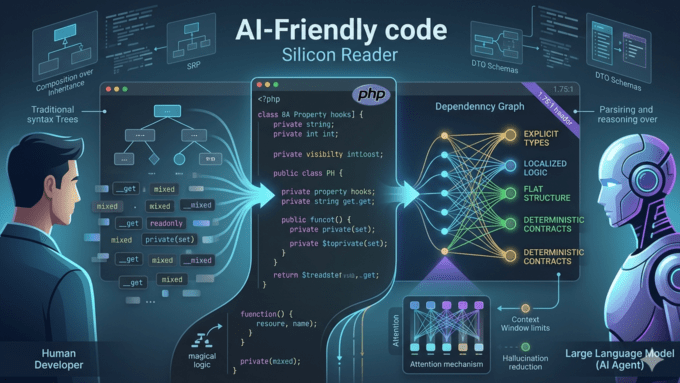
The transition to AI-native development requires an elimination of “magic” logic and dynamic ambiguity. AI models reason through token prediction. When logic is hidden behind runtime resolutions – such as magic methods or dynamic typing – the AI must speculate. Speculation leads to high-entropy outputs and hallucinations. To maximize AI comprehension, developers must use the most explicit linguistic tools available.
Strict Typing and the Death of Ambiguity
Strict typing is the most effective “guardrail” for an LLM. By providing explicit type hints for properties, arguments, and return values, the developer creates a deterministic contract. When an AI processes a file, it builds an internal representation of the data flow. If types are missing or set to mixed, the search space for the next valid token expands exponentially. This increases the probability of the AI generating code that is syntactically valid but logically incompatible with the rest of the system.
PHP 8.4 enhances this by introducing features that move logic from the “hidden” runtime into the “visible” declaration. For instance, property hooks and asymmetric visibility allow the engine – and the AI – to understand the permissions and transformations of a property at the definition level. This reduces the “context distance” the AI must travel to understand how a piece of data is handled.
| Feature | Legacy Pattern (AI-Opaque) | Modern Pattern (AI-Friendly) | AI Benefit |
|---|---|---|---|
| State Access | __get and __set magic methods | PHP 8.4 Property Hooks | Eliminates multi-step reasoning to resolve property logic. |
| Visibility | Public properties or boilerplate getters | Asymmetric Visibility (public private(set)) | Defines mutation boundaries clearly for the model. |
| Instantiation | (new Class())->method() | new Class()->method() (no parentheses) | Reduces token noise and simplifies the AST. |
| Validation | Manual checks in setter methods | Hooks with explicit type-narrowing | Localizes validation logic for the attention mechanism. |
The Power of Localized Logic via Property Hooks
Property hooks are arguably the most significant quality-of-life improvement for the “Silicon Reader.” In legacy PHP, a simple validated property required a private variable and two public methods. This structure frequently increased boilerplate by up to 70%. For an AI, this extra code is “noise.” Every additional token of boilerplate consumes space in the context window and spreads the model’s attention thinner.
By using hooks, logic is centralized. An AI reading a property definition can immediately see how it is validated and transformed without searching through the entire class for a setProjectName method. This localization is critical for maintaining “Context Coherence”. When the logic is physically close to the declaration, the AI’s self-attention mechanism assigns higher weight to the relationship, resulting in fewer errors during code generation.
Small Atomic Units and the Single Responsibility Principle
While advertised context windows for models like Gemini 3 Pro and Llama 4 Scout have reached 10 million tokens, the “Effective Context Window” (MECW) is significantly smaller. Research indicates that accuracy drops by over 30% when relevant information sits in the middle of a large file, a phenomenon called “context rot”.
For a software architect, the Single Responsibility Principle (SRP) is now a technical requirement for AI accuracy. Large “God Classes” with thousands of lines of code exceed the reliable reasoning capacity of most LLMs. Breaking systems into small, atomic units ensures that the AI only needs to process a limited set of tokens to understand a specific task. This approach minimizes the “Intrinsic Load” on the model, allowing it to dedicate more “working memory” to complex problem-solving.
| Model | Advertised Window | Effective Window (Complex Tasks) | Efficiency % |
|---|---|---|---|
| Gemini 3 Pro | 10M tokens | ~9.2M tokens | 92% |
| Llama 4 Scout | 10M tokens | ~9.7M tokens | 97% |
| GPT-4.1 | 1M tokens | ~980K tokens | 98% |
| Claude 4 Sonnet | 200K tokens | ~178K tokens | 89% |
| DeepSeek V3 | 128K tokens | ~105K tokens | 82% |
Reducing Hallucinations via Explicit Context
The primary threat to codebase integrity in the AI era is the “hallucination” – the generation of reasonable-looking but functionally incorrect code. Hallucinations occur when the AI lacks sufficient context to make a deterministic choice. In software engineering, this “Hallucination Debt” is often caused by ambiguous data structures and hidden dependencies.
Schema over Speculation: DTOs and Value Objects
Data Transfer Objects (DTOs) and Value Objects are essential for AI-friendly architecture. They define the “shape” of data in a machine-readable way. When an AI is asked to refactor an endpoint, it first looks for the data contract. If the endpoint accepts a generic array, the AI must guess the keys and types. This speculation is the root of most AI-generated bugs.
Using Symfony’s #[MapRequestPayload] with a strictly typed DTO provides the AI with a schema. This schema acts as a source of truth. The symfony/object-mapper component further simplifies this by hydrating immutable DTOs with constructor property promotion. This pattern tells the AI exactly what data is expected and how it will be validated, removing the need for the model to “vibe code” its own interpretation of the data structure.
Documentation as Metadata
Traditional documentation often explains “what” the code does, which an LLM can usually infer. To be effective today, documentation must explain the “why” – the intent and the architectural trade-offs that are not visible in the syntax. In PHP, this means using PHPDoc and Attributes as metadata rather than just comments.
For example, the new PHP 8.4 #[Deprecated] attribute is highly AI-friendly. It provides the engine and the LLM with structured information about which methods to avoid and what to use instead. This guides the AI toward modern patterns during refactoring sessions. Similarly, documenting side effects in property hooks ensures the AI understands the ripple effects of a simple assignment.
Removing Ambiguity in Edge Cases
AI models are probabilistic; they choose the most likely next token based on their training. If an edge case is not explicitly handled in the code, the AI will likely generate a “generic” path that ignores the project’s specific safety requirements. Architects must favor “exhaustive” logic structures.
The match expression is superior to if-else chains for AI comprehension. It forces a decision on all possible inputs. If a developer uses a backed enum with a match expression, the AI can immediately identify if a new case is missing. This declarative approach reduces the “Entropy Gap”—the gap between accuracy and creativity – ensuring the AI remains focused on the correct logical path.
Code Structures AI “Likes”
The mathematical architecture of transformers – specifically the self-attention mechanism – favors certain structural patterns. While humans can eventually unravel deep inheritance or complex dependencies, these structures significantly increase the “Perplexity” (confusion) of an AI model.
Composition over Inheritance
Deep inheritance hierarchies are a major source of AI confusion. When a class is five levels deep, the AI must hold the entire parent chain in its working memory to understand which properties and methods are available. This often leads to the AI hallucinating methods that do not exist or forgetting about protected properties in the base class.
Composition, by contrast, is “Flat.” By assembling objects from smaller, independent components that implement specific interfaces, the developer creates a “has-a” relationship. This is easier for an AI to parse because the dependencies are explicitly injected into the constructor. The AI can look at a single file and understand exactly which behaviors are available, leading to 17% higher accuracy in unit test generation.
Pure Functions and Predictability
Pure functions—functions where the output is determined only by the input and which have no side effects – are the “Gold Standard” for AI-friendly code. Because pure functions are stateless, the AI can reason about them in complete isolation. This isolation is critical for accurate code generation and automated testing.
In a Symfony environment, this means moving business logic out of “God Services” and into small, stateless domain experts. When a function is pure, the AI can generate 100% accurate unit tests because there are no external dependencies or global states to mock.
Interface-Driven Development
Interfaces serve as the ultimate “API Contract” for the AI. Providing an AI with an interface allows it to understand the “surface area” of a service without needing to read the implementation. This is particularly useful in large codebases where the full implementation might be too long for the context window.
Using interfaces in conjunction with the Symfony AI-agent component allows for “Tool-based” reasoning. The AI can treat a service as a tool with a defined input and output schema, allowing it to orchestrate complex workflows without getting lost in the implementation details.
| Structure | AI Sentiment | Reason |
|---|---|---|
| Composition | High | Flat structure; explicit dependencies; low memory overhead. |
| Pure Functions | High | Deterministic; easy to test; no context leaks. |
| Interfaces | High | Provides a concise “contract” or summary of intent. |
| Deep Inheritance | Low | High cognitive load; requires unrolling the tree; prone to hallucinations. |
| Magic Methods | Low | Ambiguous; requires multi-step resolution; breaks static analysis. |
Mastering the Prompt: Accuracy vs. Noise
The role of the software engineer has shifted from “coder” to “architect and supervisor.” The prompt is now the primary mechanism for defining architectural intent. “Vibe coding” – relying on vague, natural language instructions – is a primary driver of technical debt. Professional engineering requires a “Context-Rich” approach.
The Failure of Vague Prompts
A prompt like “Add a feature to save user profiles” is a disaster for a professional codebase. The AI will likely:
- Guess the database schema.
- Use deprecated PHP functions.
- Ignore project-specific security voters or rate limiters.
- Write code that “works” but is incompatible with the existing architecture.
This mismatch creates “Silent Debt.” The code looks correct and might even pass tests, but it introduces inconsistencies that will cause a “collapse of competence” when a human later tries to maintain it.
The Context-Rich Specification
Professional prompts must treat the AI as a junior developer who needs an exact specification. A high-quality prompt should include:
- Environment Definitions: “Use PHP 8.4, Symfony 7.4, and strict types.”
- Data Schemas: Provide the DTO or Entity structure directly in the prompt.
- Constraints: “Handle
UniqueConstraintViolationExceptionand return aResultobject. Do not use theEntityManagerdirectly; use theProfileRepository.” - Output Expectations: “Return a class that implements
ProfileSaverInterface.”
This “Spec-Driven Development” (SDD) approach turns the prompt into an enforceable contract. It prevents “Drift” by making assumptions explicit before the first line of code is generated.
The VibeContract Pattern
Modern research suggests a three-stage pipeline for safe code generation, known as the “VibeContract”.
- Decompose: Break the high-level prompt into discrete, atomic tasks.
- Validate: Generate and validate machine-readable contracts (interfaces/schemas) for each task.
- Generate: Guide the code generation and testing against those validated contracts.
This methodology ensures that the AI’s “creativity” is constrained by the architect’s “intent,” minimizing the risk of logical catastrophes.
The Risk Factor: The Danger of Blind Trust
The most dangerous phenomenon in the AI era is the “Lull of Correctness.” Because AI-generated code is syntactically perfect and follows common patterns, developers often skip the deep logical review required for robust systems. This leads to a severe decline in developer comprehension, or “Epistemic Debt.”
Cognitive Debt and the Collapse of Competence
Cognitive debt describes the widening gap between the complexity of a software system and the human developer’s cognitive grasp of it. When developers “outsource” logic to AI rather than “offloading” boilerplate, they bypass the cognitive friction required to build a mental model of the system.
Recent studies show that AI-assisted developers can experience a 17% reduction in conceptual understanding and debugging ability, even if they complete tasks faster. This creates “fragile experts” – developers who can generate vast amounts of code but are unable to fix it when the AI makes a subtle, logical error. To service this debt, teams must prioritize “Shared Understanding” over “Velocity”.
Security and Abstraction Leaks
AI models are trained on historical data, which includes millions of insecure coding patterns. Unless explicitly directed, an AI might suggest using outdated libraries or patterns with known vulnerabilities, such as SQL injection or weak password hashing.
In a Symfony context, security must be built into the architecture. This involves:
- Input Hardening: Using the DTO-first pattern to prevent mass-assignment.
- Authorization Voters: Using Symfony voters instead of ad-hoc
ifchecks to manage complex access logic. - Rate Limiting: Implementing multi-horizon compound rate limiting at the infrastructure level.
An AI cannot be expected to “know” these project-specific security requirements. They must be enforced through the prompt and the peer review process.
The Rubber Duck Fallacy in the AI Era
The “Rubber Duck” method is more critical than ever. Before any AI-generated code is merged, the human developer must be able to explain the logic back to themselves. If they cannot, they have lost cognitive ownership of the codebase. This ownership is the only defense against “Technical Decay” – the state where a system becomes a “black box” that no one understands.
| Risk Type | Description | Mitigation Strategy |
|---|---|---|
| Epistemic Debt | Loss of cognitive understanding of the system. | Mandatory code reviews and knowledge-sharing sessions. |
| Lull of Correctness | Blindly trusting code that looks “fine”. | Treat AI code with higher inspection than human code. |
| Abstraction Leak | AI ignoring global constraints or side effects. | Use strict architectural boundaries (e.g., deptrac). |
| Security Debt | Introduction of insecure/deprecated patterns. | Use “Secure by Design” framework features. |
Preventing Code Degradation
As AI tools increase the volume of code produced (by an estimated 3-4x), the capacity for human review is becoming the bottleneck. To prevent a total erosion of architecture, teams must implement a “Four-Layer Prevention Architecture.”
Layer 1: Specification (SDD)
Intent must be defined before code generation. Living specifications – written in structured natural language and stored in version control – ensure that assumptions are surfaced explicitly. This blocks “Drift” at the source.
Layer 2: Contract Enforcement
Schemas and formal contracts must be machine-enforceable. Using tools like Pydantic, Zod, or Symfony’s JSON Schema validation ensures that the AI’s output honors the system’s data integrity requirements at runtime.
Layer 3: Traceability
There must be a bidirectional link between intent (the spec) and implementation (the code). When a requirement changes, the system should be able to identify every affected module. This prevents “Orphaned Logic” – code that exists but no longer serves the original purpose.
Layer 4: Validation
CI/CD pipelines must verify more than just compilation. They must ensure the AI honors the code’s intent through exhaustive unit and integration testing. Using the Symfony MockAgent allows teams to test AI integrations without hitting real APIs, ensuring reliability in the testing suite.
The Role of the Software Architect
The Software Architect is no longer just a designer; they are a “Supervisor of Silicon.” Their primary value lies not in writing code, but in:
- Maintaining the Source of Truth: Ensuring the “theory” of the software remains in the minds of the human team.
- Enforcing Consistency: Preventing the “fragmented codebase” that occurs when multiple AI tools use different patterns.
- Cognitive Offloading vs. Outsourcing: Teaching the team to use AI for boilerplate (offloading) while keeping the complex logic (intrinsic load) as a human-first activity.
Summary: The Symbiotic Developer
The transition to AI-friendly code is the inevitable evolution of professional engineering. In a world where AI agents can generate code in seconds, the only code that survives is the code that is designed to be understood, verified, and extended.
Writing AI-friendly code is not about “dumbing down” the codebase; it is about “levelling up” the explicitness of our intent. By using the advanced features of PHP 8.4 and Symfony 8, architects can create systems that are both human-centric and machine-optimized. The key takeaways for any engineering team are:
- Explicitness is Safety: Use strict typing, property hooks, and backed enums to provide the AI with clear “guardrails”.
- Flat is Better than Deep: Favor composition and pure functions over deep inheritance and magic methods.
- Intent is the Source of Truth: Use spec-driven development to ensure the AI follows the architect’s plan, not its own probabilistic guesses.
- Cognitive Ownership is Non-Negotiable: Never merge code that you do not cognitively “own.” Cognitive debt is the most expensive debt a company can carry.
The symbiotic developer is not replaced by AI; they are empowered by it. By designing systems that are readable to both “Carbon and Silicon,” we ensure that our software remains an asset rather than a liability for the decade to come.
Technical Appendix: Memory and Performance Benchmarks
The necessity of AI-friendly code is rooted in the physical and mathematical limits of modern hardware. The memory required for an LLM’s working memory (the KV cache) scales with the sequence length.
The memory complexity $M$ for a transformer model can be estimated as:
Where L is the token length. For a 128,000 token codebase, the memory requirements are:
| Context Length | Approximate RAM Required | Use Case |
|---|---|---|
| 8K tokens | 4-8 GB | Medium conversations; short articles. |
| 32K tokens | 16-24 GB | Small to medium code projects. |
| 128K tokens | 64-96 GB | Entire technical documentation; large codebases. |
| 1M tokens | 200+ GB | Complete codebases with dependencies. |
When a developer uses property hooks to reduce a class from 58 lines to 18 lines , they are not just saving vertical space. They are physically reducing the memory load on the AI agent, allowing it to dedicate more “attention” to high-level logic rather than parsing boilerplate. This is why AI-friendly code is a performance optimization for the development process itself.
Check out llmfit, a terminal tool that eliminates the guesswork of local AI by automatically matching LLM models to your specific hardware. It scans your RAM and GPU to provide a “best fit” score across speed and quality dimensions, ensuring you only download models that will actually run efficiently on your machine.