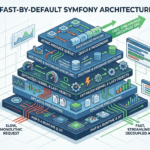

Preemptive Defense in Symfony PHP Applications

In modern Symfony architecture, security is a structural property, not a layer. Preemptive defense shifts security concerns to the earliest possible stage of the request lifecycle, ensuring that malicious or malformed data is neutralized before it reaches the domain layer. This approach minimizes the attack surface by leveraging native framework features like DTO-first validation, multi-horizon rate limiting, and signed internal communications.
Bottom Line Up Front
A robust Symfony defense requires four high-impact implementations:
- Decouple Input from Persistence: Use stateless Data Transfer Objects (DTOs) with the
#[MapRequestPayload]attribute to enforce a strict allow-list for all input, preventing mass-assignment and type-confusion vulnerabilities. - Infrastructure Verification: Hard-code
trusted_proxiesandtrusted_hoststo prevent Host-header poisoning and IP spoofing, which bypasses rate limiters and geographic blocks. - Internal Integrity: Enable Message Signing in the Messenger component (available in 7.4+) to prevent forged payload injection into your task queues.
- Declarative Runtime Protection: Implement
Token Bucketcompound rate limiters to defend against resource exhaustion and brute force at the firewall level.
Input Hardening: The DTO-First Pattern
Directly binding Doctrine entities to controllers or forms is a security anti-pattern. It couples your database schema to the public API and exposes sensitive fields (e.g., roles, password) to mass-assignment.
Implementation: Atomic Validation
Since Symfony 6.3+, the preferred pattern is to use #[MapRequestPayload] or #[MapQueryString]. This triggers deserialization and validation before the controller logic is executed.
// src/Dto/UserRegistrationDto.php
readonly class UserRegistrationDto
{
    public function __construct(
        #[Assert\NotBlank]
        #[Assert\Email]
        public string $email,

        #[Assert\NotBlank]
        #[Assert\Length(min: 12)]
        public string $password,

        // Only explicitly defined fields are mapped
    ) {}
}

// src/Controller/RegistrationController.php
#[Route('/api/register', methods: ['POST'])]
public function __invoke(#[MapRequestPayload] UserRegistrationDto $data): Response
{
    // If execution reaches here, data is already type-safe and valid.
}Tip: Use GroupSequenceProvider for multi-stage validation. This prevents expensive checks (like database lookups via UniqueEntity) from running if basic structural checks (like NotBlank) fail, reducing resource consumption during automated attacks.
Multi-Horizon Rate Limiting
Rate limiting is a resource control mechanism. A single “100 requests per minute” rule is insufficient for protecting complex endpoints like Login or Search.
Compound Throttling Strategies
Software architects should implement “Compound Limiters” (native in 7.3+) to handle both bursts and sustained load.
| Requirement | Policy | Implementation Note |
|---|---|---|
| Burst Protection | token_bucket | High limit, high refill rate. Handles rapid valid user actions. |
| Brute Force | fixed_window | Low limit (e.g., 5 attempts), long interval (15 mins). |
| Data Scraping | sliding_window | Accurate over long durations; prevents “reset-at-midnight” bypass. |
Configuration Example:
# config/packages/rate_limiter.yaml
framework:
    rate_limiter:
        login_check:
            policy: 'token_bucket'
            limit: 5
rate: { interval: '15 minutes', amount: 1 }Infrastructure & Network Trust
Failure to configure proxy trust allows attackers to spoof the X-Forwarded-For header, making all rate limiters ineffective as they will see a different IP for every request.
Trusted Proxies & Hosts
- Static IPs: Define explicit CIDRs in
framework.yaml. - Dynamic IPs (AWS/Cloudflare): Use the
REMOTE_ADDRtrust strategy, but only if your infrastructure (e.g., Security Groups) enforces that traffic originates solely from the load balancer. - Host Header: Always define
trusted_hosts. This prevents attackers from poisoning password reset links generated via absolute URLs.
# config/packages/framework.yaml
framework:
    trusted_proxies: '%env(default::TRUSTED_PROXIES)%'
    trusted_headers: ['x-forwarded-for', 'x-forwarded-proto', 'x-forwarded-port', 'x-forwarded-host']
trusted_hosts: ['^example\.com$', '^api\.example\.com$']Internal Integrity: Message Signing
In distributed systems using the Messenger component, an attacker who gains access to the transport (e.g., Redis) can inject malicious task payloads.
Symfony 7.4 Feature: Use the sign attribute on handlers to ensure that only messages produced by your application can be consumed.
#[AsMessageHandler(sign: true)]
public function handle(SensitiveTask $task): void
{
    // Signature is verified before this method is called.
}This is essential for handlers that execute shell commands or process financial transactions.
Authorization: IDOR & Voter Strategies
Role-based access control (RBAC) often leads to Insecure Direct Object Reference (IDOR) because it checks what a user is (Admin), not who owns the resource.
The “Unanimous” Strategy
For high-security domains, change the AccessDecisionManager strategy from the default affirmative (one voter “yes” wins) to unanimous.
- Voters: Move all authorization logic into Voter classes. This centralizes permission logic and makes it testable.
- Voter Metadata: 7.4+ allows passing metadata to voters, enabling more context-aware decisions without hacking request attributes.
Runtime Hardening Checklist
| Feature | Production Requirement | Impact |
|---|---|---|
| Profiler | Disable explicitly in bundles.php. | Prevents exposure of APP_SECRET and DB credentials. |
| Method Override | Set allowed_http_method_override:. | Disables verb tunneling (e.g., using POST to act as DELETE). |
| CSP Nonces | Use NelmioSecurityBundle with csp_nonce(). | Effectively eliminates XSS by whitelisting inline scripts per request. |
| Supply Chain | Run composer audit in CI/CD. | Blocks the build if dependencies have known CVEs. |
Final Tip: Stricter URL Parsing
Ensure you are on Symfony 7.3.7+ or 6.4.29+. Recent updates fixed CVE-2025-64500, where incorrect PATH_INFO parsing could lead to authorization bypass for rules relying on the / prefix.